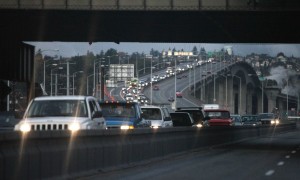
Questions about the incident today disrupting traffic on the SR99 Viaduct and future mitigation of such issues city-wide

This morning just after 6:00 AM, a van spun out and hit the guard rail on the northbound lane and crashed. It took the City of Seattle nearly two hours to get this cleared up. Multiple reports came in from hundreds of people of traffic backed up in every direction, from the stadiums back to the middle of West Seattle, all the way south past the 1st Avenue South Bridge. In short, it was a completely non-managed fiasco, and it was over the past several weeks at least the fifth time there was a major commuter transportation disruption for the West Seattle peninsula, between accidents and mistakes by government agencies. Reports across the news media and in various comment sections (and SDOT web cams) showed backups and damage from the event continuing well past 10:00 AM.

We saw nearly four hours of systemic disruption from a single crashed van that merely needed to be towed. On a weekday, there is no excuse for why the city could not get this cleared swiftly. The crash took place, as the crow flies, less than a half mile from Seattle’s City Hall and mere blocks from downtown. If we cannot service a critical north-south commuter corridor in the heart of our urban core for hours, things need to be addressed and remediated from a very high level.

In light of this, the West Seattle Transportation Coalition mailed this morning to City of Seattle Mayor Mike McGinn; Mayor-elect Ed Murray; Councilmember Tom Rasmussen, chair of the City Council’s Transportation Committee; and DeAnna Martin, Community Relations Planner from King County Metro. We asked them the following five questions:

Hello,

We are mailing in regards to the events today on the Viaduct which affected all commutes from West Seattle and points south. This was today’s event:

http://westseattleblog.com/2013/12/traffictransit-today-frozen-friday-updates

We have had now, approximately, four out of the last six commute days with extraordinary events and anger is clearly beginning to boil over with the public over the ongoing nature of these issues and  our limited, declining transportation options in West Seattle.

In order for us to transmit an explanation to our very large membership of up to 68,000 individuals, could the following be answered?

1. Why did it take two hours for a tow truck to clear an accident from the northbound viaduct this morning, when the accident happened at the height of rush hour?

2. If this was a situation where no third party tow truck was available in a timely fashion, what is the city willing and prepared to do to ensure that there will be one available in an extremely timely and highly efficient fashion going forward?

3. If this was a situation where the tow truck itself had to “fight” its way through the traffic jam itself, is there a protocol for SPD to escort safely the tow truck from the opposite direction to quickly and efficiently clear the scene?

4. If there is no such protocol as described in question #3, why not, and what steps are required for this to happen in all future incidents?

5. What sort of immediate communication was issued to Metro drivers ordering them to re-route and bypass the Viaduct, and what time was that done?

We look forward to a prompt answer to each question and steps taken to permanently ameliorate the process for these events. Seattle–not just West Seattle–has a number of critical transportation choke points in our various bridges. There must be a clear, defined, ruthlessly enforced and funded process for addressing these issues as they arise. Failure to do so and failure to address this would be unacceptable for the following reasons:

  •     It transfers tremendous personal costs in both lost time and lost money to commuters.
  •     It transfers directly financial costs in income lost for hourly employees, particularly low-income and working class employees, and those reliant upon child care.
  •     It passes tremendous costs forward and onto employers and businesses in terms of lost productivity, sales, and revenue.
  •     It allows for massive systemic disruption of our entire transportation and mass transit infrastructure, inconveniencing and passing those costs to citizens and employers across the city. As, in this case, Rapid Ride C from West Seattle is delayed for two hours, so is every Rapid Ride D that services north of the Ship Canal.

All this completely unnecessary disruption and harm to tens of thousands, for want of a single tow truck.

Thank you for your continued service and partnership.

We plan on following up on this and pursuing it until we have answers to each of the five questions in full, and until all five answers are publicized here. After the levels of raw frustration and anger we saw displayed today, the neglect in planning for West Seattle’s peninsula and residents in transportation matters has gone well past the point of reasonable patience on our part. There is no legitimate reason for us to have to wait any further for solutions.

If you would like to help us work on these issues, please check our page on volunteering, or you can simply “Like” us on Facebook here to keep updated.
South Park has joined the Coalition

The West Seattle Transportation Coalition is very happy to announce that our neighbors in the South Park Neighborhood Association (SPNA) have joined! The SPNA represents up to 5,200 South Park residents, and the WSTC will work with them to advocate on transportation related issues.

They join with the Delridge Neighborhood District Council, Genesee-Schmitz Neighborhood Council,  Morgan Community Association, Alki Community Council, the West Seattle Junction Neighborhood Organization, the Highland Park Action Committee, North Delridge Neighborhood Council, the Westwood/Roxhill/Arbor Heights Community Council, and the Admiral Neighborhood Association in endorsing our growing coalition. Today, the WSTC now helps represent up to 68,600 peninsula residents on transportation related issues and advocacy.

We are working together to improve long overlooked and long overdue transportation issues in our area. How can you help us?

  • See who endorses us: please click here for a list of all the groups and individuals who have joined the WSTC since our September 24, 2013 inauguration.
  • Come to a meeting: click here for meeting schedule information, to come to a meeting.
  • Endorse us: click here to join the coalition as an endorser and help improve transportation in the West Seattle peninsula.
  • Volunteer: click here to join our team of over twenty volunteers that are on committees and teams of the WSTC, working to implement change and forward progress for where we live.

The West Seattle Transportation Coalition is a Peninsula-wide organization working to address transportation and mobility issues for Seattle’s largest constituency. Representing more than 100,000 people living and working in the 10 square mile area between the Duwamish River and Puget Sound, these community leaders, advocates, business owners, and residents are working to address transportation and commuting challenges we face in our area. What challenges?

Would you like to know more? 

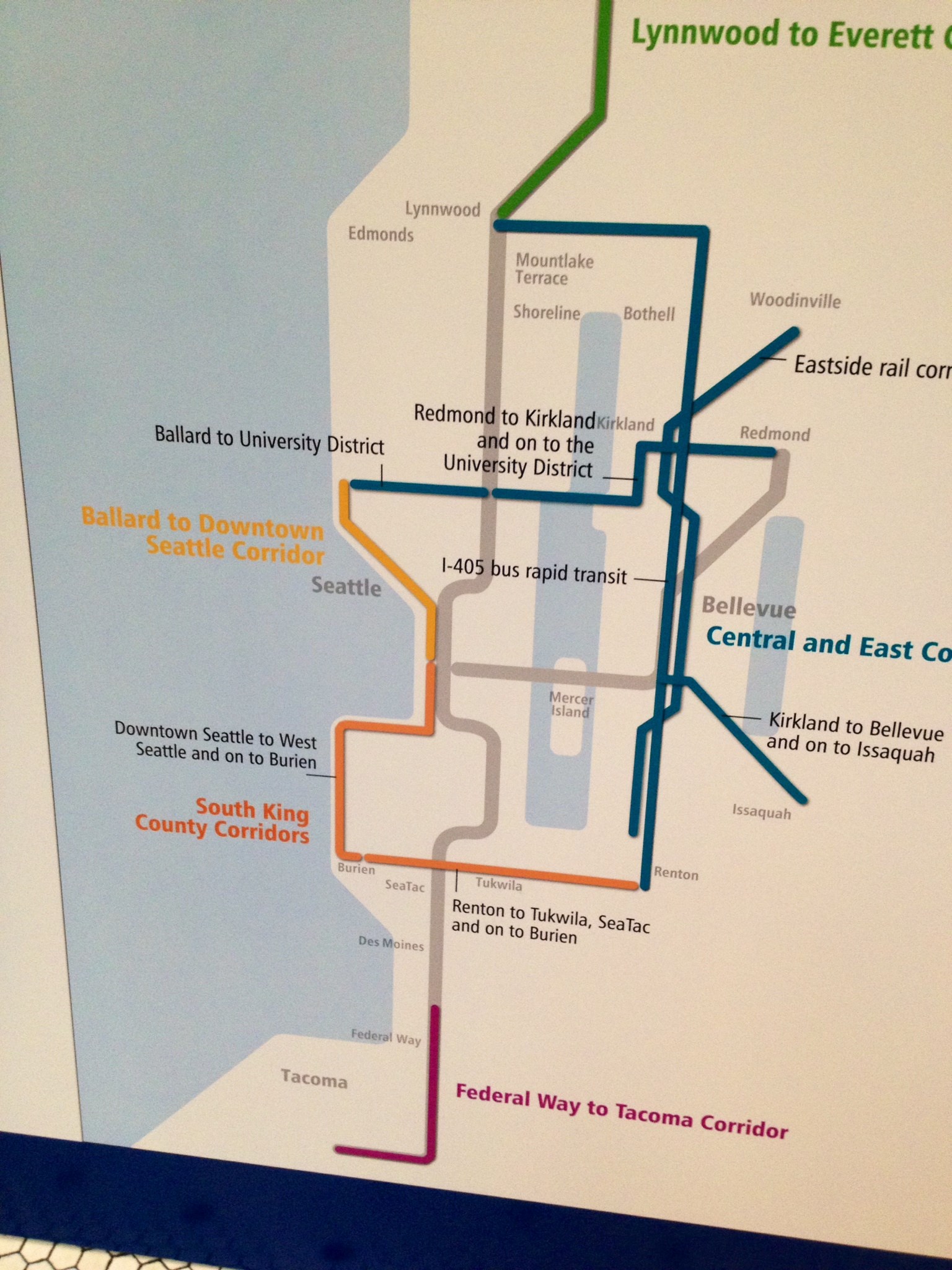
West Seattle appears to support Light Rail!

Areas under review by Sound Transit for Light Rail.

Areas under review by Sound Transit for Light Rail.

There seems to be a strong hunger in West Seattle for Light Rail expansion to, and through, West Seattle.

On November 21, members of the West Seattle Transportation Coalition attended an information hearing held by Sound Transit about the revision process for their long-range plan. Prior to this, virtually all the feedback we have heard either through the WSTC or through our various West Seattle community groups was overwhelmingly in support of and in favor of expanding Light Rail to West Seattle.

At least one community group which has endorsed the WSTC (Westwood/Roxhill/Arbor Heights Community Council) had conducted a Facebook survey of their membership to see if they favored Light Rail. The public results as of November 26 are 24-0-1 in favor of Light Rail to West Seattle (using a Yes-No-Maybe format). That is for one sample a 96% approval rate. While at the event, Sound Transit spokespeople told the WSTC that of all the West Seattle resident responses they have received in their survey that ended on November 25, the approval rate was at 94% as of November 21.

In response to this, the WSTC has drafted and sent the following letter of support to the Sound Transit comment feedback process on November 25, based on this apparently unambiguous overall support for Light Rail in our community:

(more…)

Why is our Metro service facing a 27% cut in 2014?

In case you could not find a clear and simple answer of why King County Metro may be facing 17% cuts in 2014, and why West Seattle is facing a 27% cut, we wanted to explain. There are various moving pieces here. This will explain them all, and then tie them together as it’s explained.

Home rule: Washington is not a “home rule” state, broadly. In some states, local counties (like King County) and municipalities (like Seattle) can do various things on their own to raise tax revenue without involving their state. For example, a county or city may be able to either legislatively (through their county or city council) or through a ballot measure raise a tax. We can do that here–but for almost every situation, we need the permission of the State Legislature in Olympia to do it. The process is: Olympia says, “King County, you have permission to either create Tax ABC,” which is rare, or they will say, “King County, you have our permission to ask your voters if you can create Tax XYZ,” which is far more common.

  • Short version: We need permission from people in other counties to raise taxes on ourselves.

Tim Eyman: Eyman is a conservative activist who has created various anti-tax and anti-government measures using our ballot and initiative system over the years. Some of his measures that have passed have over the years stripped King County Metro and similar public services (Eyman has testified in public on his opposition to public bus systems) of their funding sources. Historically, they used things like MVET (motor vehicle excise tax) and fees on license plate renewals. Due to some ballot measures issued through Eyman’s work, these agencies were forced to use regressive taxes such as sales taxes instead. With the recession that ran from 2008-2011 and being forced into worse economic models due to outside interference, these agencies lost massive funding and issued massive cuts. It also forced agencies like Metro to delay on some other funding rather than cut more service earlier. All of that has come home to roost now. This article on Seattle Transit Blog, here, explains the Metro financial situation in great detail.

  • Short version: Eyman initiatives combined with being forced to fund Metro via sales tax gutted it’s cash flow and reserves.

The Majority Coalition Caucus: first, please read the Wikipedia article on this subject, here. For a less objective but more detailed political overview of this, please read “The Four Horsemen of the Buspocalypse,” on the Stranger. Warning: it’s The Stranger, so there is lots of swearing. Essentially, four key Washington State Senators here in King County are holding up passage of a transportation package that would allow King County to fund itself. They are:

  • Steve Litzow (E-mail, phone: (360) 786-7641), R-41st (Mercer Island-Bellevue-Newcastle)
  • Andy Hill (E-mail, phone: 360-786-7672), R-45th (Finn Hill, Cottage Lake, parts of Redmond, Kirkland, Duvall, Sammamish)
  • Joe Fain (E-mail, phone: 360-786-7692), R-47th (Auburn-Covington-East Hill)
  • Rodney Tom (E-mail, phone: 360-786-7694) , D-48th (Medina-Redmond-Kirkland-Bellevue)

They each have various political reasons that they are doing this. Depending on who you speak to, you’ll hear a variety of different theories and explanations: Ideological opposition to public transit; fear of Tea Party challengers; intending to pass the transit funding legislation but “holding a gun to its head” in exchange for other concessions. In the end, all that matters is that for us, in King County, it’s creating massive unnecessary, unwanted, and unhelpful upheaval and uncertainty. Governor Inslee is calling a special session in roughly 48 hours to work on this problem.

  • Short version: Four state senators from our area are threatening us with up to 17% cuts to King County Metro.

The extra 10% in cuts for West Seattle: West Seattle, ever since the SR-99/Viaduct/Deep Bore Tunnel construction programs began, has been receiving an additional injection of money from the State of Washington to King County Metro. This money is specifically only for extra bus service to and from West Seattle. Without this extra service, from all of the state-sponsored construction that is in our path, our commutes to and from downtown could be as much as 30 minutes longer each way. The construction projects and tunnel–as originally legislated from Olympia–were supposed to be done in the Summer of 2014. Currently, the best guess is sometime in 2017 to 2018. However, that extra money, to keep us from being effectively trapped in our peninsula? It expires in that original legislation in seven months. This is why West Seattle is getting 27% in cuts, while the rest of King County will only get 17% in cuts. The West Seattle Transportation Coalition and some members of the City of Seattle Council are working on this problem. Even if the King County level 17% cuts are completely mitigated and stopped, right now West Seattle alone will still get a 10% cut.

  • Short version: Unless the Governor or the Legislature does something, West Seattle gets a double-barrel of cuts compared to everyone else, because of the State not keeping their commitment to us.

What can I do to help?

  • Contact the four Senators: Click on the links above for each of the four State Senators and mail them.
  • Have someone in their areas contact them: Even better, do you know anyone that lives in those districts and areas of theirs? Can you get them to call or mail those four? Representatives will take feedback from their own constituents far more seriously than feedback from people in other areas.
  • Join the WSTC: You can also join the West Seattle Transportation Coalition as a volunteer or by endorsing us.

NDNC, WWRHAH, and ANA have joined the WSTC

The West Seattle Transportation Coalition is proud to announce that we have been joined by the North Delridge Neighborhood Council (NDNC), the Westwood/Roxhill/Arbor Heights Community Council (WWRHAH) and the Admiral Neighborhood Association (ANA).

They join a wide array of other community groups and individuals across the West Seattle Peninsula, representative of up to 63,000 residents, who are working together to improve long overlooked and long overdue transportation issues in our area. How can you help them?

  • See who endorses us: please click here for a list of all the groups and individuals who have joined the WSTC since our September 24, 2013 inauguration.
  • Come to a meeting: click here for meeting schedule information, to come to a meeting.
  • Endorse us: click here to join the coalition as an endorser and help improve transportation in the West Seattle peninsula.
  • Volunteer: click here to join our team of over twenty volunteers that are on committees and teams of the WSTC, working to implement change and forward progress for where we live.

The West Seattle Transportation Coalition is a Peninsula-wide organization working to address transportation and mobility issues for Seattle’s largest constituency. Representing more than 100,000 people living and working in the 10 square mile area between the Duwamish River and Puget Sound, these community leaders, advocates, business owners, and residents are working to address transportation and commuting challenges we face in our area. What challenges?

Watch the first ten minutes of this video:

Would you like to know more? 


We’re looking for Committee volunteers! YOU can fix our problems.

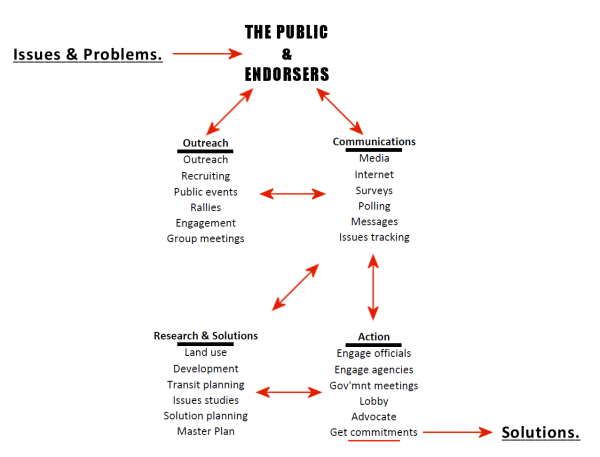
The West Seattle Transportation Coalition is made up of the following Committees, and is looking for volunteers. To join any of them or for more information about them, please email to info@westseattletc.org. You will be joining a team of twenty committed local volunteers.

Outreach Committee

  • What Outreach does: The evangelists. Engagement with businesses, community groups, special interest groups and individuals for recruiting into the coalition, education, and to collect feedback for the coalition to act upon.
  • Chair: Deb Barker

Communications Committee

  • What Communications does: The geeks and skunkworks operators. Manages the WSTC’s online presences; conducting annual/bi-annual Issues Surveys; writing press releases; managing and facilitating communications between other advocacy groups. Sometimes serving as the squeaky wheel for the other committees.
  • Chair: Joe Szilagyi

Research and Solutions Committee

  • What R&S does: The technical people and planners. Develops and adjusts the West Seattle Peninsula Transportation Master Plan by receiving and disseminating research info from Outreach, Communications & Meetings. Works directly with DPS, SDOT, WSDOT, EPA, etc. for research on technical, planning, and transportation solutions.
  • Chair: Kevin Broveleit

Action Committee

  • What Action does: The advocates. Meets with officials (elected and otherwise); agencies; goes to and holds rallies; engages directly with whomever is required for West Seattle to get commitments for solutions.
  • Chair: Amanda Kay Helmick


How do the committees work to improve transportation on the West Seattle Peninsula? Something like this:

Want to join a committee to improve your community?
Send an e-mail to: info@westseattletc.org

WSTC Meeting agenda for November 12, 2013

Here is the agenda for our Tuesday, November 12th, 2013 meeting. The WSTC has it’s internal structure sorted out. How can you help? What do YOU want to work on, for your community of 105,000 people in the southwest?

We’ve got outreach–recruiting, going out to get feedback. We’ve got communications–polling, surveys, the internet, to get feedback. We’ve got research & solutions–working on land use, planning, technical planning. We’ve got action–going out to rallies, to meetings with agencies and elected officials.

Agenda:

6:30: Welcome and Updates

6:40: Introduction, Vote & Ratify Committees

Communications Committee

Roles: Online presence; Annual/bi-annual Issues Surveys. Writing press releases. Managing and facilitating communications between other advocacy groups. Works in tandem with all other Committees.

Action Committee

Roles: Calls Coalition to action, meets with elected officials, attends public hearings, and manages the Calendar. Works in tandem with all other Committees.

Outreach Committee

Roles: Community Outreach; Engagement with businesses, community groups, special interest groups, individuals, etc. Works in tandem with all other Committees.

Research & Solutions

Roles: Develops and adjusts the Master Plan by receiving and disseminating research info from Outreach, Communications & Meetings. Works directly with DPS, SDOT, WSDOT, EPA, etc for additional information and feedback. Works in tandem with all other Committees.

7:30: Communications Committee. Technology and Surveying; Joe Szilagyi

7:45: Action Committee. Call to Action; Amanda Kay Helmick

8:00: Outreach Committee. Listening Tour; Deb Barker

8:15: Research & Solutions Committee. Master Plan; presenter TBD

8:30: Other Items: Q&A; Community News, etc.

West Seattle Transportation Coalition

  • Tuesday, November 12th, 2013 6:30 – 9:00 PM
  • Neighborhood House – High Point, 6400 Sylvan Way SW
  • Click here for a PDF copy of the Agenda: WSTC_Agenda_111213Final

Join us on Facebook: http://www.facebook.com/westseattletc 

ACC, HPAC, JuNO join the West Seattle Transportation Coalition

The West Seattle Transportation Coalition is proud to announce that the Alki Community Council (ACC), the West Seattle Junction Neighborhood Organization (JuNO), and the Highland Park Action Committee (HPAC) have endorsed the WSTC.
They join with the Delridge Neighborhood District Council, Genesee-Schmitz Neighborhood Council, and Morgan Community Association in association in endorsing our growing coalition.

Today, the WSTC now helps represent up to 34,600 peninsula residents on transportation related issues and advocacy.

The following individuals have also added their names to endorse the WSTC:

  • Katharine Christian, West Seattle Family Dentistry
  • Susan Conn
  • Allison Dobbins
  • Lezlie Jane

Please click here for a list of all the groups and individuals who have joined the WSTC in the exactly 31 days since our September 24, 2013 inauguration. Click here for meeting schedule information, to come to a meeting. Click here to join the coalition and help improve transportation in the West Seattle peninsula. Why should you join?

(more…)

West Seattle groups and residents endorse the WSTC

The West Seattle Transportation Coalition is proud to announce on October 18, 2013, our first public endorsements from groups and individuals for WSTC to help represent them on transportation-related issues. The following groups have endorsed the WSTC:

The following individuals have endorsed the WSTC:

  • Brian Allen
  • Jon Coombes
  • Theresa Harnett
  • Madeline Johnson
  • Ksenya Lagutina
  • Tom Rickell
  • Linda Ruffer
  • Kerrie Shurr
  • Martin Talarico
  • Chris Wallace

(more…)

Call to action from the West Seattle Transportation Coalition

The West Seattle Transportation Coalition is a Peninsula-wide organization working to address transportation and mobility issues for Seattle’s largest constituency.

Representing more than 100,000 people living and working in the 10 square mile area between the Duwamish River and Puget Sound, these community leaders, advocates, business owners, residents and workers focused on addressing transportation and commuting challenges caused by:

  • The reduction of mass transit services: The current insufficient level of service will be compounded by the proposed cuts in our already under served area.
  • Loss of infrastructure: The scheduled removal of the SR-99 Viaduct without sufficient replacement capacity on other routes to and from our Peninsula.
  • Density without transportation capacity:  The region’s commitment to increased density is not matched with equivalent increases in transportation capacity to serve the Peninsula’s steadily growing population.
  • Natural barriers: West Seattle has only limited routes connecting it to downtown and beyond for the vast majority of its commuters. Mass transit is the primary option that can move us across these choke points to keep our transportation systems functioning.

The West Seattle Transportation Coalition calls upon our city, county and state elected officials to produce permanent solutions to these identified challenges affecting our Peninsula.

We call upon the City of Seattle to:

(more…)

West Seattle Transportation Coalition © 2014 Frontier Theme